The Salad Playbook: every good salad is six slots and a sauce
Why most "what's in my fridge" apps fail, and how I designed one around a formula instead of a recipe list, so you stop needing the app.

Purvang Mehta · Product designer
28 September 2026 · 1 min read
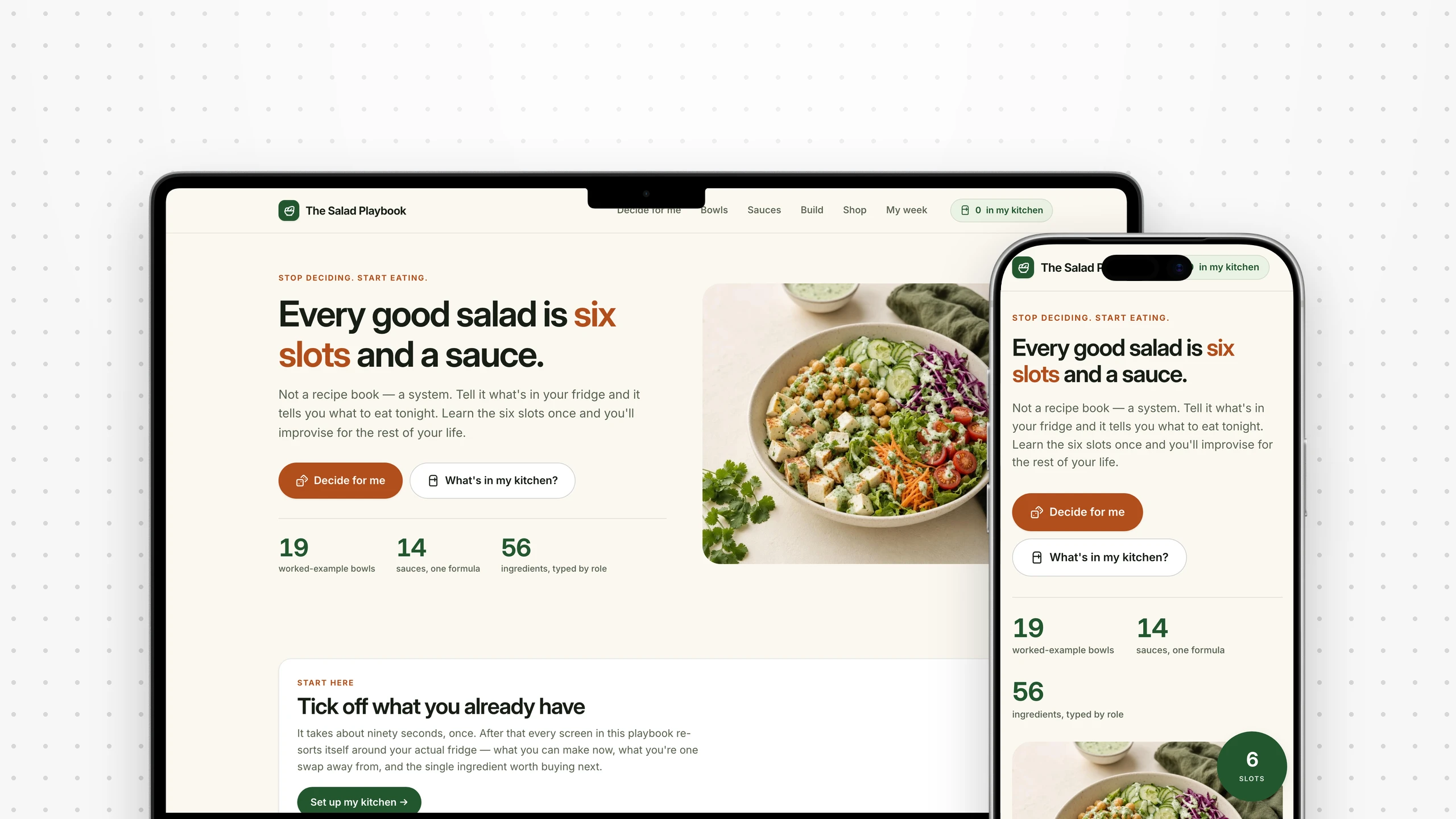
Standing in front of an open fridge at 8pm is a decision problem, not a recipe problem. More recipes don't fix that. They add to it.
6
slots and a sauce
19
worked-example bowls
14
sauces, one formula
56
ingredients, typed by role
Why fridge apps fail
A menu of fixed combinations doesn't cure decision fatigue. It is decision fatigue. And apps that need an exact match send you shopping over one missing vegetable.
The formula
- 01
Base
- 02
Protein
- 03
Crunch
- 04
Creamy
- 05
Sharp
- 06
Finish, then a sauce
Every bowl is a worked example of the formula, with the reasoning shown. Dressings follow one too: base, flavour, acid, sweet, seasoning.
Four design decisions
A grammar, not recipes
Teach the formula. The bowls are examples.
Swap by role
Radish for carrot is a swap, not a failure.
Shop by leverage
Buy one lemon, five dinners open up.
The week decays
Fragile things get eaten first.
Swaps stay honest. Tofu never quietly replaces paneer, and past two swaps a bowl stops claiming to be ready. Over-promising is the fastest way to lose trust.
How it's made
No build step, no backend, no account. Everything stays in your browser, and nothing is sent anywhere. Built in August 2026, with AI.